
Topics of the week 39

From the traditional Alpine cattle descent to a look back at 20 years of the Asylum Act, the high-tech hunt for Asian hornets, and the political debate surrounding the 'Lex Ermotti'. The topics of the week highlight defining Swiss moments.
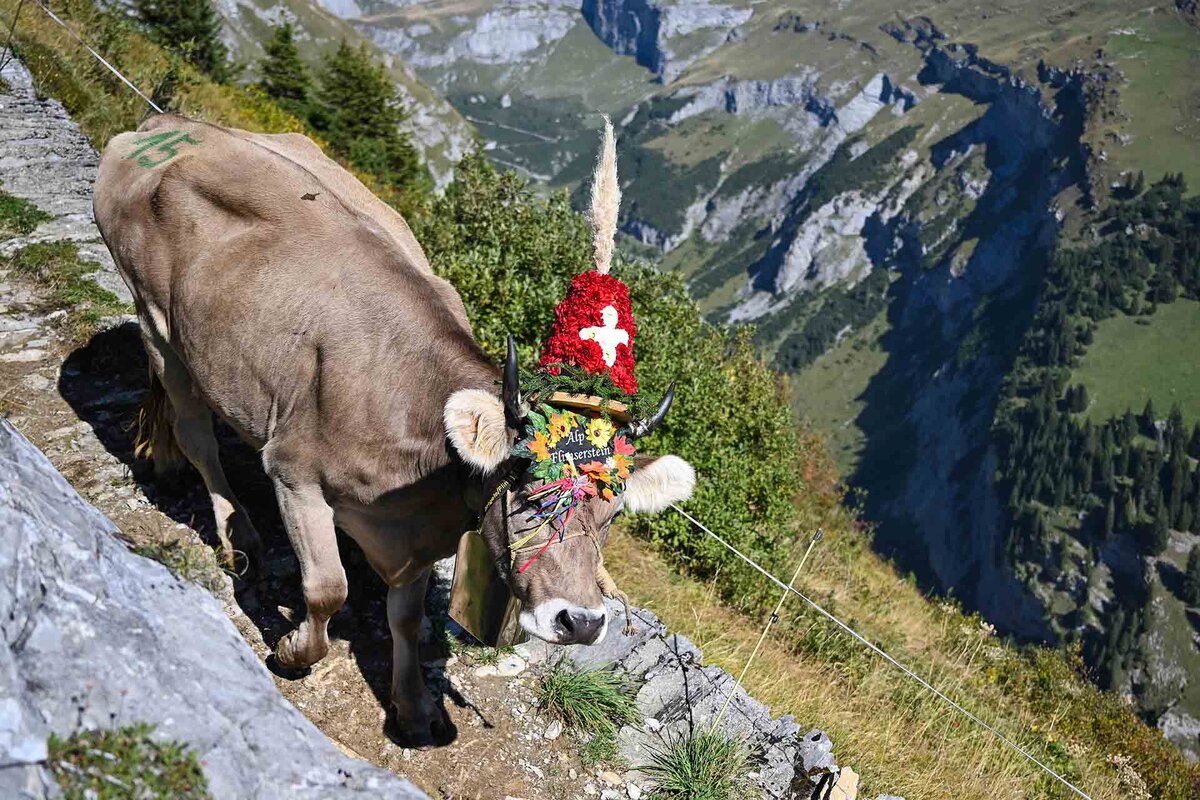
Alpine cattle descent
Focus
After about four months in the high pastures, tens of thousands of cows, goats, and alpine dairymen return to the valley in festive decorations. What looks like pure folklore at first glance is a massive logistical effort for Swiss mountain agriculture, but also an important economic factor for regional tourism, attracting thousands of visitors.
From the elaborate floral decorations ('Tschäppel') and heavy cowbells to the traditional costumes, the descents at the end of September symbolize the end of the alpine summer and the beginning of the production of protected alpine cheese specialties.
The fact that this year's festive procession brings a particular sense of relief is evident when looking at the weather anomalies of the past few months. The hot and dry summer demanded considerable adaptability to nature from the alpine farmers. Where springs dried up in the high pastures or the grass withered early, the farms reacted flexibly.
Some herds were moved down to the valley earlier as a precaution, or feed was carefully rationed. The fact that the alpine summer was managed without major incidents despite these climatic challenges makes the agricultural sector celebrate the traditional processions with even greater pride.

20 years of the 2006 Asylum Act – The echo of a historic vote
Flashback
Exactly two decades ago, on September 24, 2006, the Swiss electorate set a milestone in migration policy: with a clear majority of 67.8 percent, voters approved the revised Asylum Act. It was the provisional climax of a highly polarized debate that had lasted for years.
Among other things, the bill introduced the controversial fast-track exclusion for people without identification documents, cut social assistance for rejected asylum seekers in favor of emergency aid, and drastically tightened coercive measures during deportations.
A look back reveals a striking temporal parallel to the current autumn session of parliament. Then as now, the same fundamental questions were at the center of the political debate: how does the constitutional state deal with rising asylum applications and logistical bottlenecks in the cantons without abandoning its humanitarian tradition?
The directional decision of 2006 shapes Swiss asylum practice to this day and shows that the struggle to strike a balance between control, immigration management, and the protection of fundamental rights remains a constant issue in recent Swiss history in the Federal Palace.

0,2
Numbers
The invasion of the Asian hornet is currently sweeping through Switzerland with full force. 'The Asian hornet is one of the most invasive species Switzerland has ever seen,' biologist Carine Vogel explains to Keystone-SDA. In addition to hotspots in western Switzerland, the insect is spreading rapidly in other cantons (VD, GE, JU, BS, BL, AG, SO, BE).
This is devastating for the local biodiversity. A single nest houses up to 13,000 individuals and consumes several kilograms of insects per season, primarily attacking beehives.
To track down the mostly well-camouflaged nests 10 to 30 meters up in the treetops, experts rely on complex telemetry. Specialists such as Geneva beekeeper Kévin Golay catch individual hornets and equip them with tiny radio transmitters weighing just 0.2 grams.
The insects fly back to their queen with the additional load, guiding the experts directly to the hiding place via an antenna. As soon as the location is pinpointed via the radio frequency signal, special teams move in for the extermination. The effort is necessary: if a single nest survives the late autumn, up to 500 new young queens will emerge from it for the following year.

Lex Ermotti
Hintergrund
Sergio Ermotti is the man of the hour in the Swiss financial center and the chief architect of a banking colossus whose total assets of $1.6 trillion far exceed the Swiss economic output.
After the Ticino native had already restructured UBS from 2011 to 2020 following the financial crisis, Chairman of the Board Colm Kelleher brought him back as the preferred successor to the ill-fated Ralph Hamers. Ermotti's mission: the historically unique Herculean task of integrating the failed Credit Suisse.
However, shortly before the decisive debate in the Federal Palace, the UBS boss went on the attack and suffered a sensitive defeat. With accusations directed at the supervisory authorities Finma and SNB, as well as sharp criticism of Finance Minister Karin Keller-Sutter, Ermotti wanted to avert the impending stricter capital requirements. But his rhetorical broadside achieved the exact opposite in the Council of States.
Legal experts speak openly of a polarization caused by Ermotti's appearance, which drove the parliament even further away from the banking giant. The upper chamber voted surprisingly clearly on Wednesday with 33 to 10 votes in favor of a massive tightening of the Banking Act.
Whether the National Council will stick to this hard line in the coming weeks or meet UBS halfway with a more moderate compromise will show how much power Ermotti's word still has in Bern.